
3 Circles Evangelism Tool
how to use the 3 circles tool
You don't need a script. You don't need to memorize a presentation. You just need a simple picture — one you can draw on a napkin, sketch on your phone, or trace with your finger on a table.
People share their pain with us all the time. Marriage trouble. Financial stress. A kid who's going off the rails. Loneliness they can't shake. Depression they can't explain. They're not always asking for answers — but they're telling us something is broken.
The 3 Circles gives you a way to meet people right there, in their brokenness, and walk them gently toward hope.
How 3 circles works
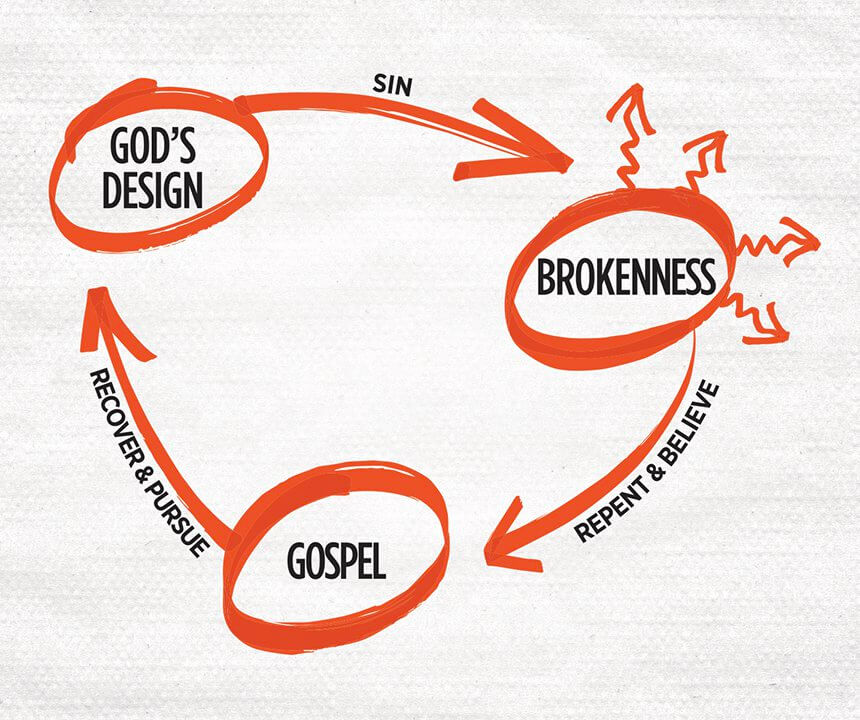
Circle 1: God's Design
God made this world and He made it good. He designed life to work — relationships to thrive, people to have purpose, everything to fit together. When life feels like it should be better than this, that feeling is actually evidence that we were made for something more.
→ Arrow: Sin
We chose our own way. We stepped outside of God's design — and the Bible calls that sin. Not a guilt trip. Just an honest name for the gap between the life God intended and the life we're actually living.
Circle 2: Brokenness
That gap leads to brokenness. We see it everywhere — and we feel it personally. Broken relationships. Empty achievements. The sense that no matter what we try, something is still off.
→ Arrow: Repent & Believe
The way out of brokenness isn't trying harder. It's turning — turning from our own way and turning to Jesus. That's what repentance and belief mean in plain language.
Circle 3: Gospel
Jesus lived the life we couldn't live. He died to carry the weight of our sin. He rose from the dead to open the door back to the life God designed for us. That is the Gospel. That is the good news.
→ Arrow: Recover and Pursue
Once we're restored to God, we begin recovering His design in every area of our lives. And when we fall — because we will — we don't go back to brokenness. We return to the Gospel. That's the cycle. That's how it works.
How to use it in a conversation
Step 1: Start where they are.
When someone shares a struggle, gently acknowledge it. "It sounds like that part of your life feels really broken right now." You're not diagnosing them — you're listening. Meeting them where they are.
Step 2: Point toward something better.
"Can I show you something? There's a reason life feels like it should be better than this — because it was designed to be." Sketch the first circle.
Step 3: Name what broke it.
"The Bible calls the gap between God's design and how we actually live sin — it just means we've all gone our own way." Draw the arrow. Draw the brokenness circle. Keep it honest and keep it humble — this is your story too.
Step 4: Bring the good news.
"But here's where it gets good." Draw the Gospel circle. Tell them what Jesus did. Keep it simple: He lived, He died, He rose — and that changes everything.
Step 5: Invite them.
"The way out of brokenness is to repent and believe — to turn from our own way and put our trust in Jesus. That's it." Invite them to take that step. Maybe they're ready right now. Maybe they need to think. Either way, you've planted something real.
Conversation Starters
- "Can I share something with you that completely changed the way I see my life?"
- "When I was going through something like that, I found something that actually helped. Can I tell you about it?"
- "Have you ever seen this thing called the 3 Circles? It's a really simple picture that changed how I understand everything. Can I show you?"
- "I know this might sound unexpected, but do you have any kind of faith background? I'd love to hear your story."
Reflection Questions
- Practice drawing the 3 Circles on paper right now until you can do it without looking. It takes about 5 minutes.
- Try explaining the whole thing out loud — to yourself, to your mirror, to a friend who already knows Jesus. Practice makes it feel natural.
- Who is one person in your life you could share this with this week?